
Biofeedback Exercise
Electrocardiogram recordings (middle-row signal) and beat-to-beat heart rate dynamics (bottom) were translated into visual features of the virtual environment, providing users with real-time information about their physiological state (i.e., biofeedback). The intensity of the sea (flashing) reflected cardiac activity, while its color represented moment-to-moment changes in heart rate, ranging from lower heart rate values in purple to higher heart rate values in teal. By adapting breathing (top) frequency, depth, and structure toward slow diaphragmatic breathing, participants could increase HRV, typically expressed as a stronger rise in heart rate during inhalation and a stronger decrease during exhalation. Participants could follow a breathing pacer (shuttling sphere) that guided respiration rhythm and displayed instantaneous heart rate.
Visual artifacts and reduced smoothness are introduced by the recording/compression process and are not present in the original application.
Virtual Reality-Based HRV Biofeedback
Human-Machine Interface • Neuroadaptive Systems • Mindfulness Technology
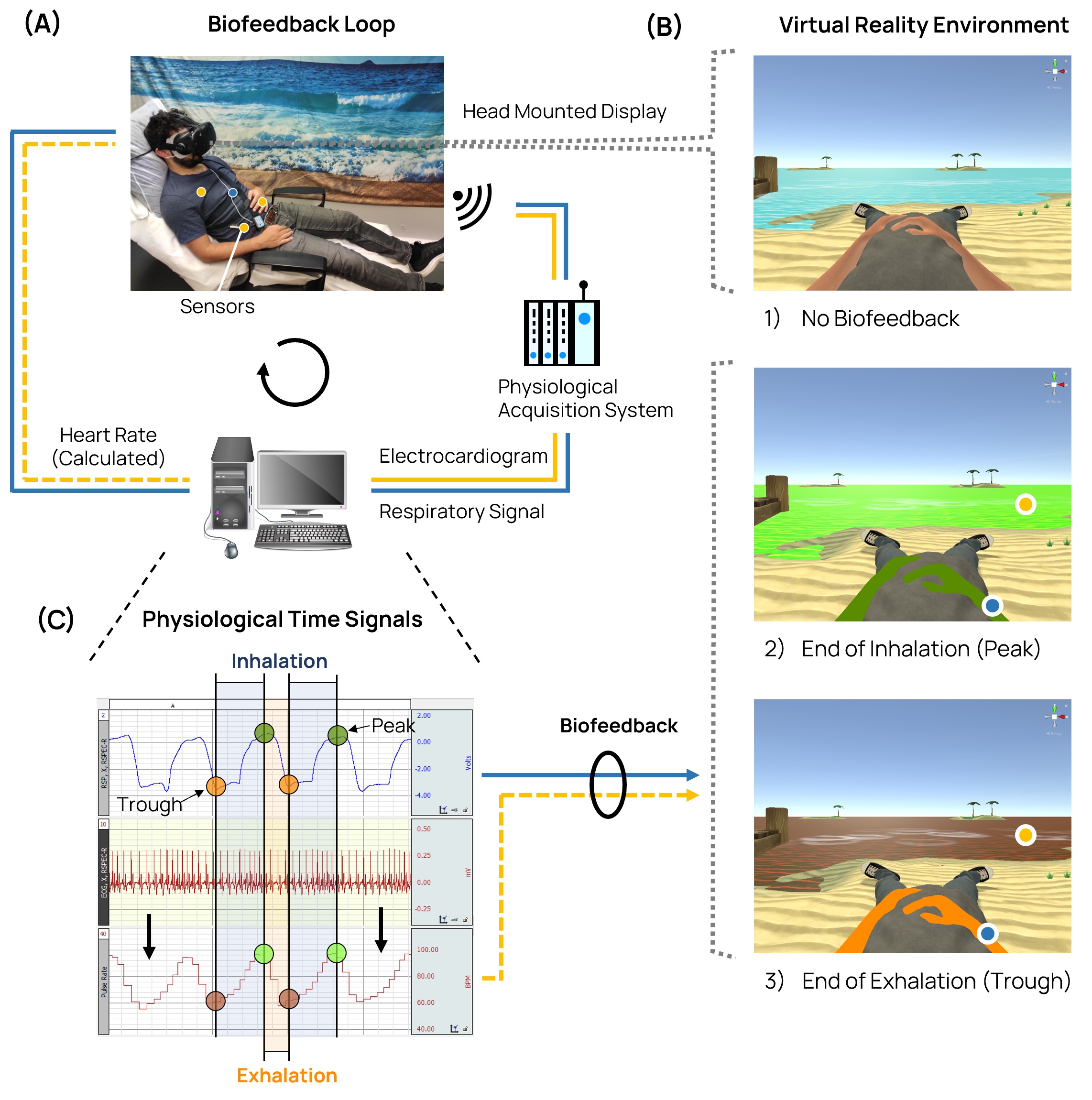
During my doctoral research, I developed a virtual reality-based HRV biofeedback system that allows users to consciously influence physiological processes linked to cognition, emotion, and wellbeing. By displaying instantaneous heart rate directly within the virtual environment, users can adapt their breathing in real time to increase their heart rate variability (HRV). Slow diaphragmatic breathing promotes parasympathetic activity of the autonomic nervous system and more coordinated physiological rhythms, which are associated with relaxation, efficient body functioning, and flexible adaptation to stress¹.
In simple terms, the system helps users become more aware of the interaction between body and mind and intentionally shift their physiological state toward greater calm and self-regulation.
HRV Biofeedback Effects
HRV biofeedback has been shown to improve cardiovascular functioning as well as physical and mental health², including stress-related conditions. Clinical research demonstrated beneficial effects for disorders such as anxiety³ and depression⁴ ⁵. Neuroimaging studies further indicate that HRV biofeedback can change brain structure and function, particularly in regions involved in emotion regulation, attention, and self-control⁶ ⁷ ⁸ ⁹ ¹⁰.
In essence, HRV biofeedback can be understood as a form of nervous system training that strengthens the body’s capacity to remain balanced, adaptive, and resilient under stress.
System Setup
Participants could sit or lie comfortably while cardiac and respiration signals were continuously recorded. Heart rate was calculated online from the interval between electrocardiogram peaks (heartbeats). Different virtual reality environments were developed in which heart rate dynamics were displayed through the sea, while respiration amplitude was represented through changes in the avatar’s body color..
Cognitive Assessment
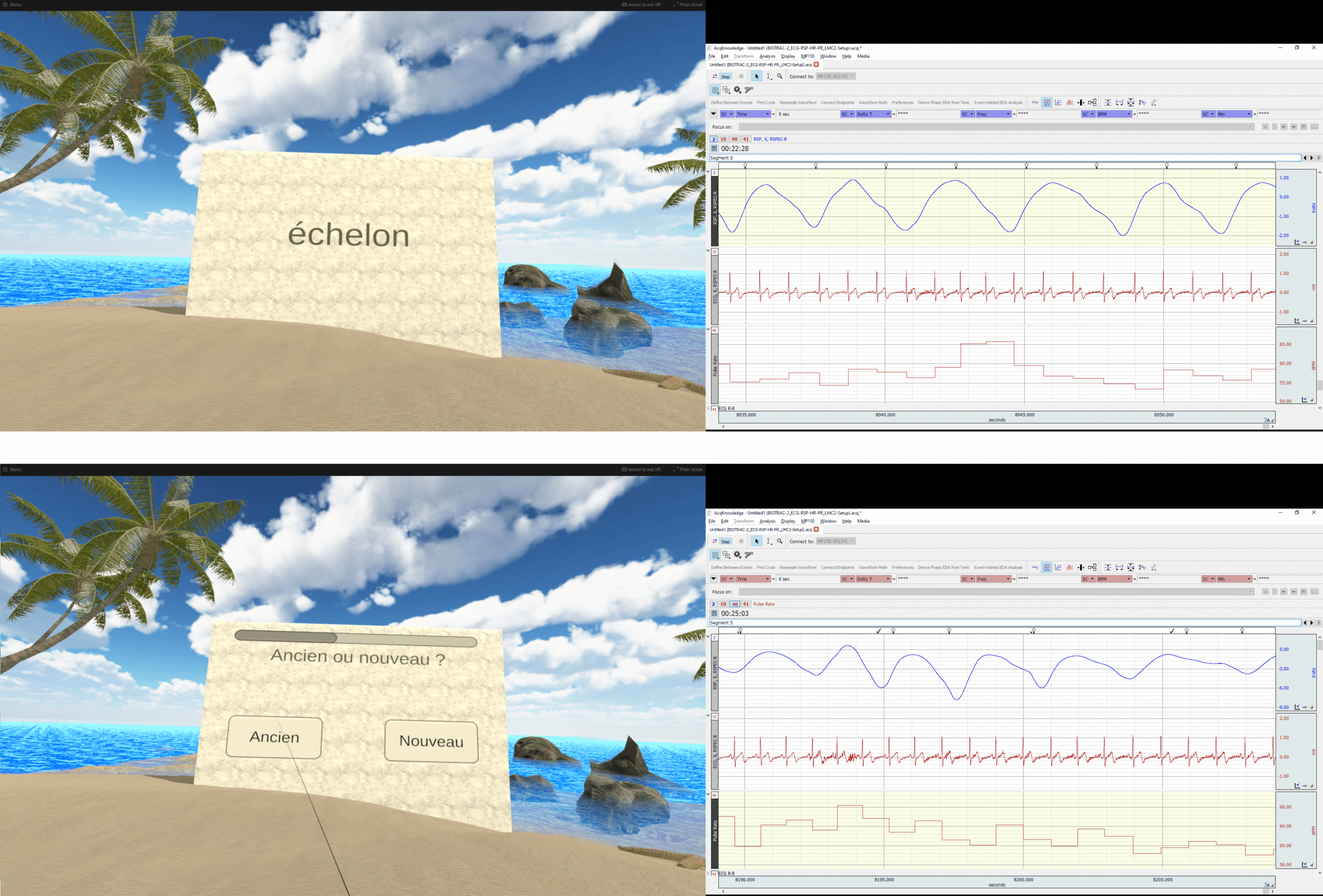
Different experimental cognitive tasks were implemented in virtual reality following HRV biofeedback (left). These included the Deese–Roediger–McDermott paradigm to investigate true and false memory, as well as a mental time travel task examining properties of autobiographical memory and episodic future thinking. Continuous physiological measures were recorded throughout task performance (right).
Research Use
In my research, as part of the BIOTRAC (BIOfeedback TRAining and Cognition) studies, I implemented HRV biofeedback to investigate how physiological regulation interacts with cognitive regulation of memory, thoughts, and emotions. Virtual reality was used to create a more immersive and motivating biofeedback experience while also improving experimental controllability and robustness. For the first time, HRV biofeedback and cognitive assessment were integrated into a unified virtual reality platform to study immediate physiological and cognitive effects simultaneously. For example, we investigated how HRV biofeedback influences true-to-false memory discrimination and characteristics of autobiographical memory and future-oriented thinking.
BIOTRAC Studies
Further information about the HRV biofeedback system, technical implementation, and experimental protocols can be found in the publicly accessible BIOTRAC research projects.
Explore Research Projects
Mindfulness & Self-Regulation
Learn more about the Mindfulness-Based Stress Reduction (MBSR) program as an evidence-based training in self-regulation, awareness, and stress resilience.
Technical Projects
Applied systems and experimental platforms for psychophysiology, VR, and digital health.
overview
Project Portfolio
A broader overview of my technical projects portfolio including the BIOTRAC studies and selected further work.
Explore Projects →

Repository
BIOTRAC-2 System
A demonstration of the virtual reality biofeedback system used in the BIOTRAC-2 study on false memories.
View Demo →

repository
BIOTRAC-3 System
A demonstration of the virtual reality biofeedback system used in the BIOTRAC-3 study on mental time travel.
View Demo →
References
1. Lehrer, P. M., Vaschillo, E., & Vaschillo, B. (2000). Heart rate variability biofeedback: How and why does it work? Applied Psychophysiology and Biofeedback, 25(3), 177–191.
2. Lehrer et al. (2020). Heart Rate Variability Biofeedback Improves Emotional and Physical Health and Performance: A Systematic Review and Meta Analysis. Applied Psychophysiology and Biofeedback, 45(3), 109–129. https://doi.org/10.1007/s10484-020-09466-z
3. Goessl et al. (2017). The effect of heart rate variability biofeedback training on stress and anxiety: A meta-analysis. Psychological Medicine, 47(15), 2578–2586. https://doi.org/10.1017/S0033291717001003
4. Pizzoli et al. (2021). A meta-analysis on heart rate variability biofeedback and depressive symptoms. Scientific Reports, 11(1), 6650. https://doi.org/10.1038/s41598-021-86149-7
5. Vann-Adibe et al. (2025). Efficacy and Methodology of Remote Heart Rate Variability Biofeedback Interventions for Mental Health: A Systematic Review and Meta-Analysis. Applied Psychophysiology and Biofeedback. https://doi.org/10.1007/s10484-025-09750-w
6. Yoo et al. (2022). Heart rate variability (HRV) changes and cortical volume changes in a randomized trial of five weeks of daily HRV biofeedback in younger and older adults. International Journal of Psychophysiology, 181, 50–63. https://doi.org/10.1016/j.ijpsycho.2022.08.006
7. Schumann et al. (2021). The Influence of Heart Rate Variability Biofeedback on Cardiac Regulation and Functional Brain Connectivity. Frontiers in Neuroscience, 15, 775. https://doi.org/10.3389/fnins.2021.691988
8. Nashiro et al. (2022). Effects of a randomised trial of 5-week heart rate variability biofeedback intervention on mind wandering and associated brain function. Cognitive, Affective, & Behavioral Neuroscience, 22(6), 1349–1357. https://doi.org/10.3758/s13415-022-01019-7
9. Nashiro et al. (2023). Increasing coordination and responsivity of emotion-related brain regions with a heart rate variability biofeedback randomized trial. Cognitive, Affective, & Behavioral Neuroscience, 23(1), 66–83. https://doi.org/10.3758/s13415-022-01032-w
10. Cho et al. (2023). Changes in Medial Prefrontal Cortex Mediate Effects of Heart Rate Variability Biofeedback on Positive Emotional Memory Biases. Applied Psychophysiology and Biofeedback, 48(2), 135–147. https://doi.org/10.1007/s10484-023-09579-1