

Heart rate variability (HRV) describes the natural fluctuations in the time between successive heartbeats. Rather than beating at a constant rhythm, the heart continuously adjusts from one moment to the next, reflecting the dynamic activity of the autonomic nervous system.
The organism is constantly engaged in regulation, maintaining stability while adapting to changing internal and external demands. HRV provides a direct window into this process. As such, HRV is widely used as an indicator of physiological and psychological self-regulation and has been linked to overall health and resilience.
HRV as marker of autonomic functioning
The body and the mind continously orchestrate physiological and psychological processes to adapt to internal and external environment. This includes regulating blood pressure, breathing, hormonal activity, and attention. A central role in this regulation is played by the autonomic nervous system, which extends from the brainstem and spinal cord throughout the body. It innervates and controls many vital organs, including the heart, lungs, and gastrointestinal system.
Heart rate is not static but constantly adjusted to meet changing demands. For example, it increases when we stand up, engage in physical activity, or experience emotional arousal, and decreases during rest.
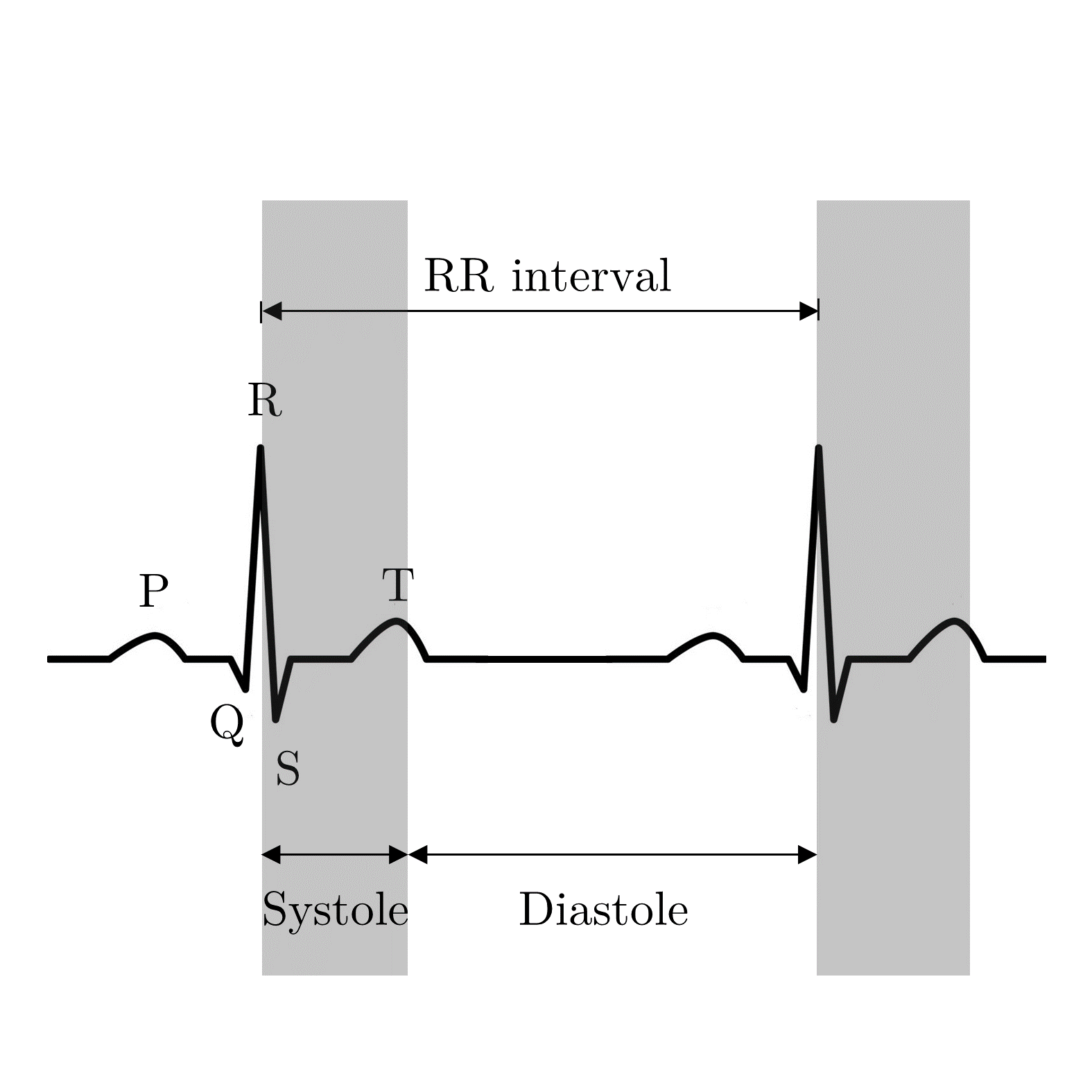
Importantly, these adjustments also occur on a much faster timescale within seconds. HRV captures these rapid, beat-to-beat changes by measuring the intervals between successive heartbeats (e.g., the RR intervals in an electrocardiogram, Figure 1). These fine-grained fluctuations provide a window into autonomic regulation.
Sympathetic and parasympathetic regulation
The autonomic nervous system is commonly described as consisting of two interacting branches:
- The sympathetic nervous system, which mobilizes the body for action (e.g., increasing heart rate during stress or effort). Linked to fight-or-flight response.
- The parasympathetic nervous system, which supports recovery and restoration (e.g., lowering heart rate during rest). Linked to rest-and-digest response
Rather than acting independently, these systems continuously interact to regulate cardiac activity. HRV reflects this interplay, capturing how flexibly the system can shift between states of activation and recovery.
The importance of the vagus nerve
The main conduit of parasympathetic activity is the vagus nerve, which connects the brain to many organs in the body. Most of the time, heart rate is governed by vagal (parasympathetic) activity. Pacemaker cells in the top of heart preset an intrinsic rhythm of around 110 beats per minute, reduced by parasympathetic input to typical resting levels around 60-80 bpm. Thus, the vagus nerve is often described as a “brake” on the heart: its activation reduces heart rate and its release increases heart rate.
The vagus nerve acts as a brake on the heart. By rapidly engaging and releasing this brake, it allows the heart rate to change from one beat to the next. Higher HRV reflects more flexible vagal control.
This is important because the organism depends on how well vagus nerve can brake. In healthy individuals, this vagal control is highly dynamic. The heart rate can change rapidly from one beat to the next, resulting in higher HRV. This flexibility allows the organism to efficiently adapt to changing demands.
HRV as an indicator of self-regulation and health
Beyond its role in regulating organ function, the vagus nerve is also linked to large-scale brain networks involved in emotion, attention, and cognitive control. HRV is therefore increasingly understood as an index of self-regulation, reflecting how effectively the body and brain coordinate responses to challenges.
Higher levels of HRV have been associated with:
- overall physical and mental health¹ ² ³
- stress resilience⁴ ⁵ ⁶
- improved cognitive performance⁷ ⁸ ⁹ ¹⁰ ¹¹
- better regulating emotions and thoughts⁵ ¹¹ ¹² ¹³
In contrast, lower HRV is often observed in conditions involving chronic stress or reduced adaptability, including burnout, anxiety, depression, PTSD, and cardiovascular risk.
Can HRV be trained?
Maintaining a flexible and adaptive autonomic system is central to health. HRV is not fixed and can be influenced through lifestyle and training.
Practices that have been shown to increase HRV include: regular physical activity, breathing exercises, mindfulness and meditation, and HRV biofeedback training.
These approaches aim to sustainably strengthen self-regulation capacity by reshaping its underlying neurophysiological and psychological processes.
References
1. Gevirtz, R. (2013). The promise of heart rate variability biofeedback: Evidence-based applications. Biofeedback, 41(3), 110–120. DOI: 10.5298/1081-5937-41.3.01
2. Lehrer, P., Kaur, K., Sharma, A., Shah, K., Huseby, R., Bhavsar, J., & Zhang, Y. (2020). Heart rate variability biofeedback improves emotional and physical health and performance: A systematic review and meta analysis. Applied Psychophysiology and Biofeedback, 45(3), 109–129. DOI: 10.1007/s10484-020-09466-z
3. McCraty, R., & Shaffer, F. (2015). Heart rate variability: New perspectives on physiological mechanisms, assessment of self-regulatory capacity, and health risk. Global Advances in Health and Medicine, 4(1), 46–61. DOI: 10.7453/gahmj.2014.073
4. Andreassi, J. L. (2010). Psychophysiology: Human behavior and physiological response (5th ed.). Psychology Press.
5. Holzman, J. B., & Bridgett, D. J. (2017). Heart rate variability indices as bio-markers of top-down self-regulatory mechanisms: A meta-analytic review. Neuroscience & Biobehavioral Reviews, 74, 233–255. DOI: 10.1016/j.neubiorev.2016.12.032
6. Thayer, J. F., & Lane, R. D. (2000). A model of neurovisceral integration in emotion regulation and dysregulation. Journal of Affective Disorders, 61(3), 201–216. DOI: 10.1016/S0165-0327(00)00338-4
7. Forte, G., Favieri, F., & Casagrande, M. (2019). Heart rate variability and cognitive function: A systematic review. Frontiers in Neuroscience, 13, 710. DOI: 10.3389/fnins.2019.00710
8. Hansen, A. L., Johnsen, B. H., & Thayer, J. F. (2003). Vagal influence on working memory and attention. International Journal of Psychophysiology, 48(3), 263–274. DOI: 10.1016/S0167-8760(03)00073-4
9. McCraty, R. (2003). The energetic heart: Bioelectromagnetic interactions within and between people. HeartMath Research Center, Institute of HeartMath.
10. McCraty, R., Atkinson, M., Tomasino, D., & Bradley, R. T. (2009). The coherent heart: Heart–brain interactions, psychophysiological coherence, and the emergence of system-wide order. Integral Review, 5(2), 10–115.
11. Thayer, J. F., & Lane, R. D. (2009). Claude Bernard and the heart–brain connection: Further elaboration of a model of neurovisceral integration. Neuroscience & Biobehavioral Reviews, 33(2), 81–88. DOI: 10.1016/j.neubiorev.2008.08.004
12. Ottaviani, C., Medea, B., Lonigro, A., Tarvainen, M., & Couyoumdjian, A. (2015). Cognitive rigidity is mirrored by autonomic inflexibility in daily life perseverative cognition. Biological Psychology, 107, 24–30. DOI: 10.1016/j.biopsycho.2015.02.011
13. Ottaviani, C., Thayer, J. F., Verkuil, B., Lonigro, A., Medea, B., Couyoumdjian, A., & Brosschot, J. F. (2016). Physiological concomitants of perseverative cognition: A systematic review and meta-analysis. Psychological Bulletin, 142(3), 231–259. DOI: 10.1037/bul0000036