

Next MBSR Courses
Next online courses in English will start in Autumn 2026. 

8 weekly sessions of 2.5 hours (online) + mindfulness day of 6 hours (online).
Course updates will be published here.
To receive updates directly, please use the contact form or email me at contact@lukasboegge.com.
Next in-person courses in German will start in Autumn 2026. 

8 weekly sessions of 2.5 hours (in person) + 1 mindfulness day of 6 hours (in person).
Course updates will be published here.
To receive updates directly, please use the contact form or email me at contact@lukasboegge.com.
Based on the standards of the German MBSR-MBCT Association. Training and supervision with Günter Hudasch.
Mindfulness Programs for Organizations
Customized mindfulness and stress-reduction programs for organizations and companies, available in German, English, or French.
What is MBSR?
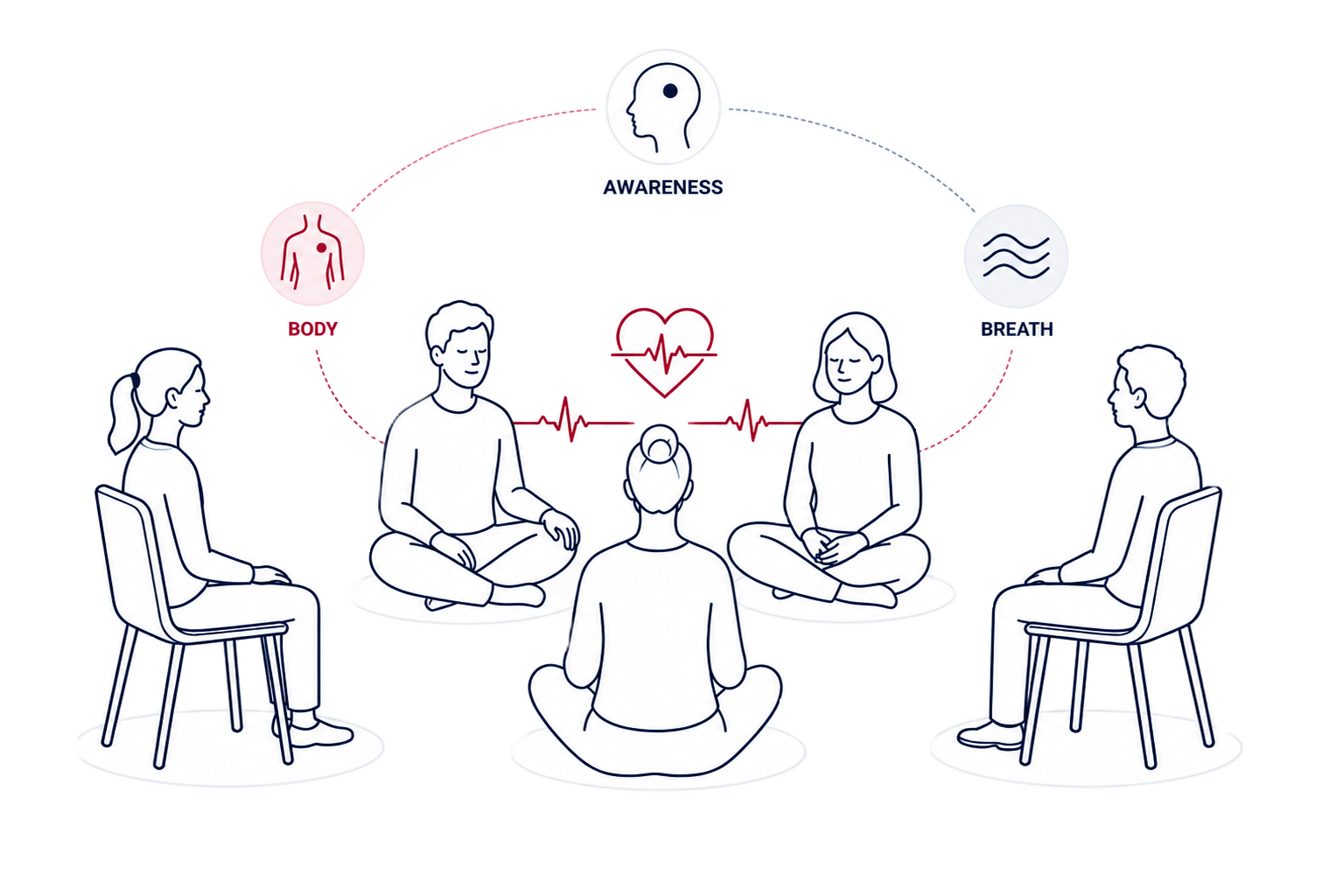
MBSR is an 8-week training program that combines meditation, body awareness, psychoeducation, and gentle movement to cultivate mindful awareness. It develops the capacity to observe thoughts, emotions, and bodily sensations in the present moment with openness and without judgment.
Awareness of internal states and external context is essential for how we regulate behavior and emotions, often automatically. MBSR strengthens this awareness, making these processes more conscious and flexible. This helps reduce habitual or reactive patterns and supports more adaptive, intentional responses in everyday life.
The program consists of weekly group sessions, a full-day retreat, and daily home practice. Participants engage in core practices such as body scan, sitting meditation, and mindful movement, and learn to integrate mindfulness into daily activities to gradually build attention, emotional balance, and self-regulation.
Why MBSR?
MBSR is one of the most extensively researched mindfulness-based interventions, with consistent evidence across clinical and non-clinical populations.
Core benefits include:
- Reduced stress¹
Improved resilience and lower perceived stress levels - Improved mental health²
Reductions in anxiety and depressive symptoms - Enhanced emotion regulation³
Greater capacity to respond rather than react - Support for pain and physical health⁴
Improved coping with chronic pain and illness - Better attention and clarity⁵
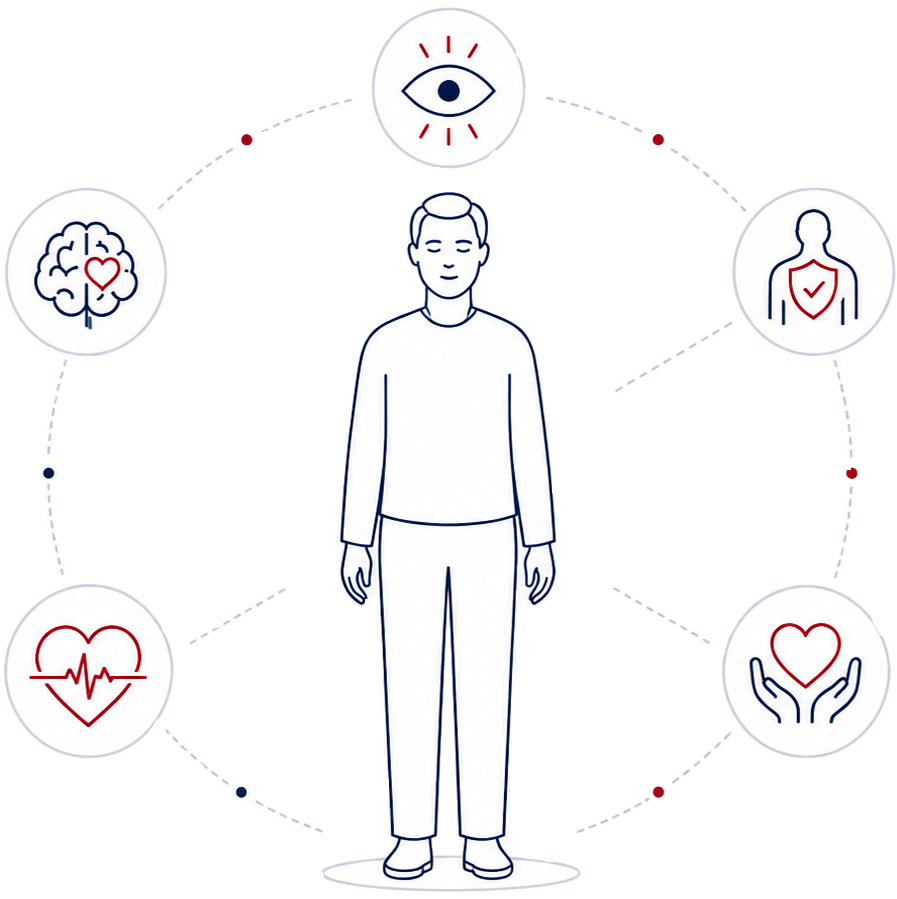
Increased focus and reduced mental distraction - Brain reorganization⁶ ⁷
Changes in brain activity, connectivity and volume
What is Mindfulness?
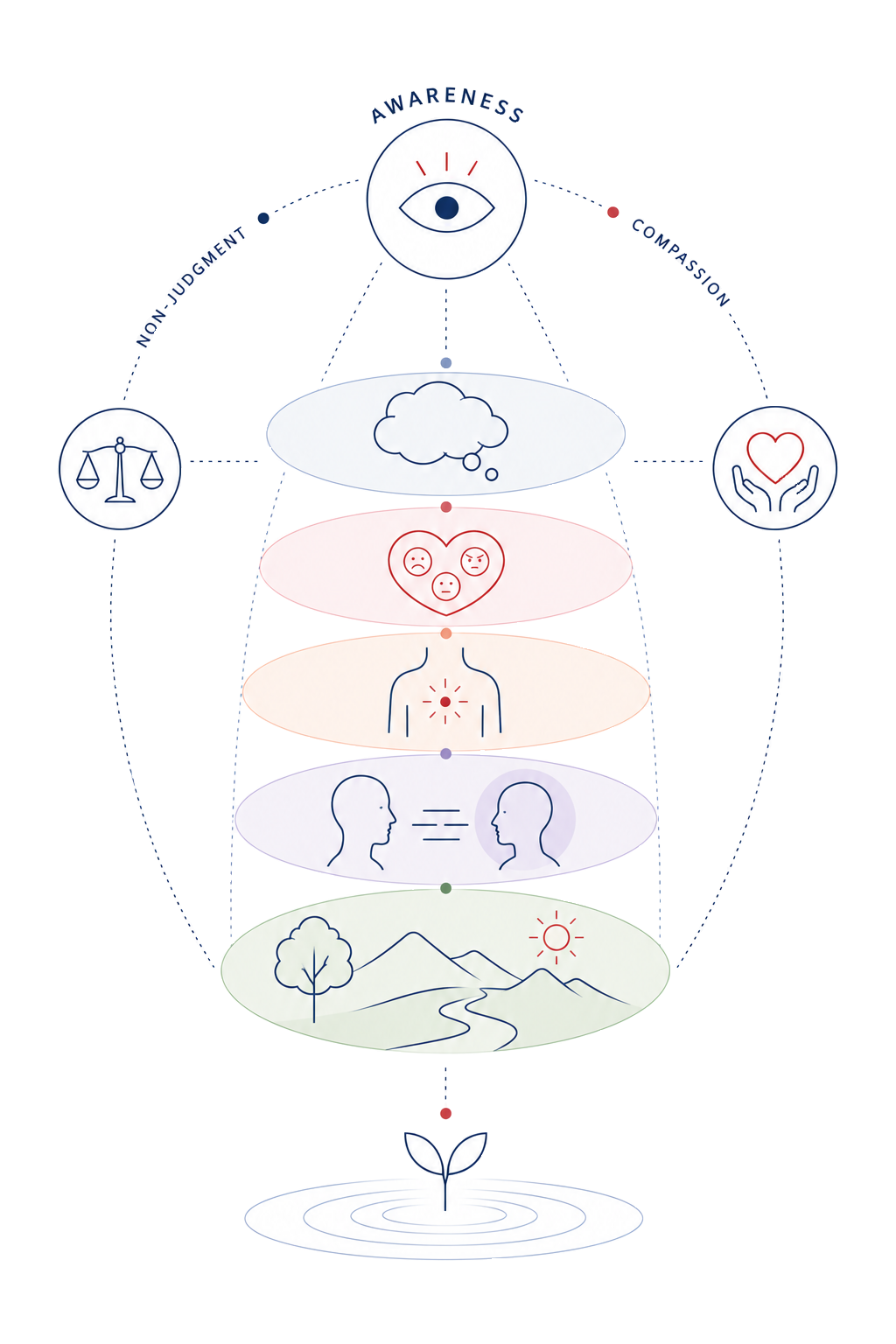
Mindfulness, the core of MBSR, is the practice of paying attention to present-moment experience with openness and without judgment. Being mindful means being aware of internal states like thoughts, emotions, bodily sensations as well as on-going actions and the surrounding environment.
Much of human functioning is governed by automatic processes, including habits and learned response patterns that often operate outside of awareness. Mindfulness introduces a form of monitoring that increases meta-awareness and self-knowledge, making these processes more accessible. This allows behavior and emotional responses to become more flexible and better aligned with intentions and goals.
Rather than being absorbed in thoughts about the past or future, mindfulness involves directly experiencing the contents of life that are unfolding within and around us in the present moment. An essential component is the attitude toward experience: by cultivating a non-judgmental, curious, and compassionate stance, the relationship to thoughts, emotions, and sensations shifts. Experiences that may initially feel overwhelming or aversive can be observed with greater equanimity and curiosity.
In this sense, mindfulness can be understood as putting on a new pair of glasses: it does not change the content of experience itself, but how it is perceived, ultimately shaping how we respond to it.
References & MBSR Studies
1. Khoury, B., Sharma, M., Rush, S. E., & Fournier, C. (2015). Mindfulness-based stress reduction for healthy individuals: A meta-analysis. Journal of Psychosomatic Research, 78(6), 519–528. https://doi.org/10.1016/j.jpsychores.2015.03.009
2. Hofmann, S. G., Sawyer, A. T., Witt, A. A., & Oh, D. (2010). The effect of mindfulness-based therapy on anxiety and depression: A meta-analytic review. Journal of Consulting and Clinical Psychology, 78(2), 169–183. https://doi.org/10.1037/a001855
3. Hölzel, B. K., Lazar, S. W., Gard, T., Schuman-Olivier, Z., Vago, D. R., & Ott, U. (2011). How does mindfulness meditation work? Proposing mechanisms of action from a conceptual and neural perspective. Perspectives on Psychological Science, 6(6), 537–559. https://doi.org/10.1177/1745691611419671
4. Grossman, P., Niemann, L., Schmidt, S., & Walach, H. (2004). Mindfulness-based stress reduction and health benefits: A meta-analysis. Journal of Psychosomatic Research, 57(1), 35–43. https://doi.org/10.1016/S0022-3999(03)00573-7
5. Jha, A. P., Krompinger, J., & Baime, M. J. (2007). Mindfulness training modifies subsystems of attention. Cognitive, Affective, & Behavioral Neuroscience, 7(2), 109–119. https://doi.org/10.3758/CABN.7.2.109
6. Gotink, R. A., Meijboom, R., Vernooij, M. W., Smits, M., & Hunink, M. G. M. (2016). 8-week Mindfulness Based Stress Reduction induces brain changes similar to traditional long-term meditation practice: A systematic review. Brain and Cognition, 108, 32–41. https://doi.org/10.1016/j.bandc.2016.07.001
7. Pernet, C. R., Belov, N., Delorme, A., & Zammit, A. (2021). Mindfulness related changes in grey matter: A systematic review and meta-analysis. Brain Imaging and Behavior, 15, 2720–2730. https://doi.org/10.1007/s11682-021-00453-4
How does the MBSR course look like?
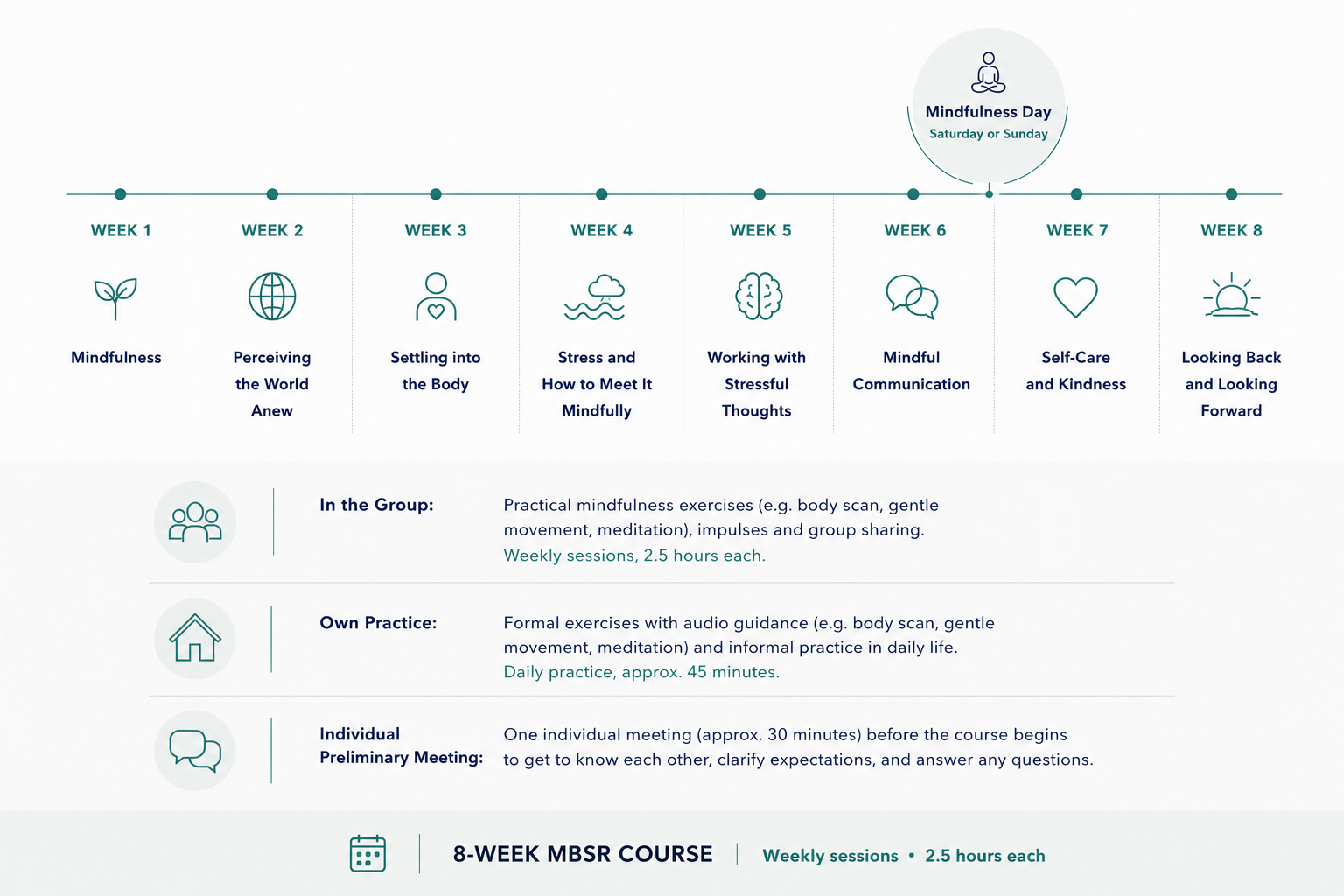
1. Introductory Conversation
2. The MBSR Course
The course consists of eight weekly group sessions of 2.5 hours each, as well as a 6-hour mindfulness day during the second half of the course. Groups are intentionally kept small, with a maximum of 12 participants.
- What is mindfulness?
- Perception and awareness
- Being grounded in the body
- Stress and responding mindfully
- Working with stress-amplifying thoughts
- Mindful communication
- Self-care and compassion
- Integration and moving forward
3. Your Personal Practice
An essential part of the course is the daily mindfulness practice at home. During the eight weeks, participants are encouraged to practice around 45 minutes per day, allowing the teachings to move from theory into lived experience.
Practices include:
- Body Scan
- Mindful movement and gentle Hatha Yoga
- Sitting and walking meditation
You will receive guided audio recordings for home practice, as well as a comprehensive workbook to support your learning during and beyond the course.
4. Course Completion
Many participants choose to continue aspects of their mindfulness practice beyond the eight-week course and integrate it into their daily lives in a way that feels supportive and sustainable for them. Continuing the practice over time can further strengthen and deepen the effects developed during the course, including greater calm, self-regulation, and presence in everyday life.
Frequently Asked Questions (FAQs)
MBSR can be beneficial for anyone who wishes to cultivate greater awareness, balance, and resilience in daily life. Participants often join the course because they would like to better cope with stress, regulate emotions more effectively, reduce rumination and improve sleep, or reconnect with a greater sense of presence and inner calm.
Others seek support in navigating challenging periods of life, including psychological or physical difficulties, and wish to respond to themselves with more kindness and less self-criticism. Many participants also appreciate developing practical tools and exercises that can be integrated into everyday life, helping them recognize stress patterns earlier, care for their wellbeing more consciously, and build a more grounded relationship with themselves and others.
While we often cannot fully control external circumstances, we can learn to change how we relate and respond to them. Through regular mindfulness practice, you become more aware of habitual thought patterns, emotional reactions, and automatic behaviors that contribute to stress.
This increased awareness creates space to respond more consciously rather than react automatically. Over time, many participants experience greater calm, emotional balance, self-compassion, and resilience in everyday life, including during challenging situations, pain, or illness.
Since the very first MBSR course in 1979, the program has been continuously studied in scientific research. Today, MBSR is one of the most extensively researched mindfulness-based interventions, supported by more than 45 years of clinical and scientific investigation.
Thousands of studies and meta-analyses have examined the effects of MBSR and compared it with other approaches such as relaxation training, stress management programs, or yoga. Research has shown that participation in an MBSR course can support a healthier relationship with stress, improved concentration and emotional regulation, greater ability to relax, increased wellbeing and vitality, as well as enhanced empathy and social connectedness.
No. The MBSR program is designed for participants both with and without prior experience in meditation or mindfulness practice.
For the in-person course, all essential materials are provided on site. You are welcome to bring a notebook for personal reflections and, if you prefer, your own meditation cushion.
For the online course, you will need:
- a quiet and private space where you can practice without interruption (everyday background sounds are completely fine)
- a device with camera and microphone, such as a computer, laptop, or tablet
- a stable internet connection
- enough space for a yoga mat and gentle movement exercises
Both online and in-person MBSR courses have been scientifically evaluated and show comparable benefits for stress reduction and wellbeing. The format that suits you best mainly depends on your personal preferences, lifestyle, and circumstances.
Participants often appreciate the online format because it allows them to practice directly within their everyday environment, without commuting or additional travel time. It also offers greater flexibility for people with busy schedules, frequent travel, chronic illness, or physical limitations.
Others value the in-person format because it provides a dedicated space away from daily distractions, more informal connection with the group, and a refreshing break from screen-based routines. Practical materials such as mats and cushions are also available on site.
Whichever format you choose, both course options aim to support greater awareness, resilience, and a calmer relationship with stress in everyday life.
If you are interested in joining an MBSR course, we will first meet for a free and non-binding introductory conversation via Zoom, which lasts around 30 minutes. In this confidential setting, we will talk about what brings you to the course, your intentions and expectations, and how the mindfulness practices may fit into your daily life.
Based on this conversation, we can explore together whether the course is a good fit for you.
You can schedule an introductory conversation by contacting me.
Once you sign up for the conversation, I will reserve a place for you in the corresponding course without obligation. After the meeting, you can decide whether you would like to register for the course officially.
Cancellation is possible in text form (e.g. by email).
- Up to 14 days before the start of the course: cancellation fee of €50
- Less than 14 days before the start of the course: the full course fee becomes payable, as places are reserved specifically for each participant.
If you are unable to attend, you are welcome to nominate a substitute participant upon prior agreement.
Please note that refunds can generally no longer be provided once the course has started. Further details can be found in the in the Terms and Conditions.