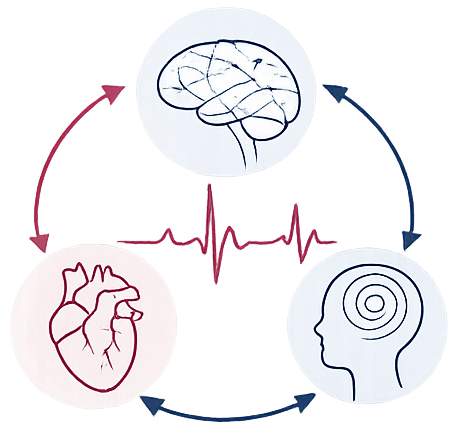
Connecting and Stimulating Body and Mind
My research in psychophysiology focuses on how the nervous system interacts with cognitive abilities such as memory and thought regulation, and how both can be stimulated.
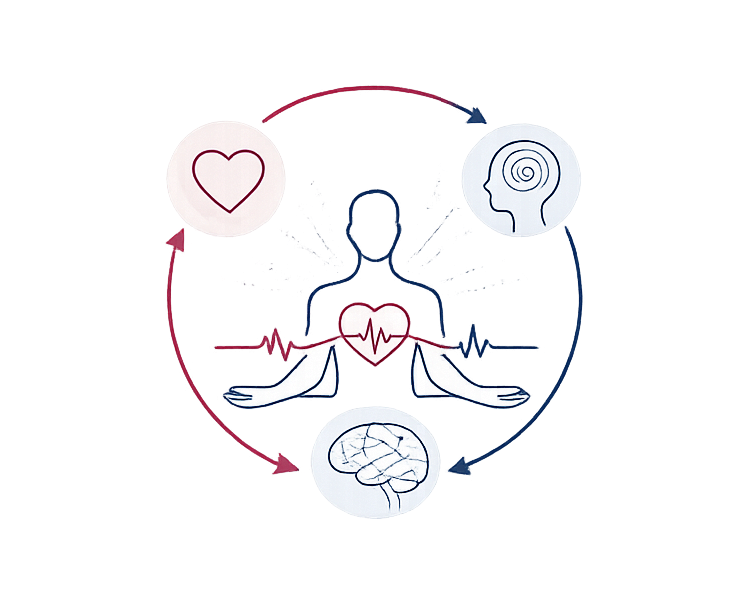
In particular, I investigated the importance of the natural fluctuations in heart rate, termed heart rate variability (HRV). HRV has been shown to reflect the complex dynamics of the central and autonomic nervous system that underlie the body’s capacity to adapt to environmental demands, such as coping with stress¹ ². HRV not only provides insight into physiological self-regulation, but is also linked to cognitive processes³ and mental health¹ ², including anxiety⁴ and depression⁵, with higher levels generally reflecting greater adaptability and more healthy self-regulation.
HRV Biofeedback in Virtual Reality
In my work, I extended this line of psychophysiology research to higher-level cognitive functions such as remembering the past and imagining the future, processes that occupy up to 50% of our waking mental activity. Across three experimental human studies, I explored how HRV is associated with the self-relevance, emotional quality, and cognitive control of memory and future-oriented thought.
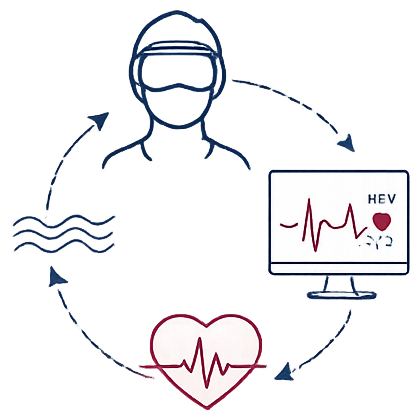
To investigate this, I led the BIOTRAC (BIOfeedback TRAining and Cognition) studies and developed a virtual reality system that integrated cognitive assessment in a controlled immersive environment with HRV biofeedback for psychophysiological stimulation⁵ ⁶. The system allowed participants to increase their HRV and associated physiology, which we compared with immediate and persistent cognitive changes.
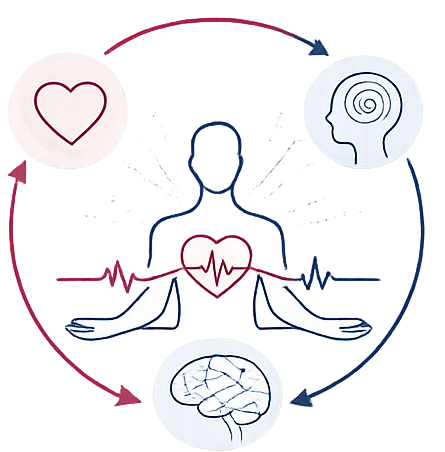
Self-Regulation Exercise
The findings suggest that physiological self-regulation, indexed by HRV, is closely connected to the cognitive-affective regulation of thought. They underline the importance of maintaining flexible autonomic functioning (i.e., high HRV) for healthy cognitive functioning, as well as its modulation through self-regulation practices such as HRV biofeedback and mindfulness-based interventions.
References
1. Julian F. Thayer & Richard D. Lane (2009). Claude Bernard and the heart–brain connection: Further elaboration of a model of neurovisceral integration. Neuroscience & Biobehavioral Reviews, 33(2), 81–88. DOI: 10.1016/j.neubiorev.2008.08.004
2. Julian F. Thayer et al. (2012). A meta-analysis of heart rate variability and neuroimaging studies: Implications for HRV as a marker of stress and health. Neuroscience & Biobehavioral Reviews, 36, 747–756. DOI: 10.1016/j.neubiorev.2011.11.009
3. Giuseppe Forte, Francesca Favieri, & Maria Casagrande (2019). Heart rate variability and cognitive function: A systematic review. Frontiers in Neuroscience, 13, 710. DOI: 10.3389/fnins.2019.00710
4. Joshua J. Chalmers et al. (2014). Anxiety disorders are associated with reduced heart rate variability: A meta-analysis. Frontiers in Psychiatry, 5, 80. DOI: 10.3389/fpsyt.2014.00080
5. Andrew H. Kemp et al. (2010). Impact of depression and antidepressant treatment on heart rate variability: A review and meta-analysis. Biological Psychiatry, 67(11), 1067–1074. DOI: 10.1016/j.biopsych.2009.12.012
6. Paul Lehrer et al. (2020). Heart Rate Variability Biofeedback Improves Emotional and Physical Health and Performance: A Systematic Review and Meta-Analysis. Applied Psychophysiology and Biofeedback, 45(3), 109–129. DOI: 10.1007/s10484-020-09466-z
Mindfulness & Self-Regulation
Learn more about the Mindfulness-Based Stress Reduction (MBSR) program as an evidence-based training in self-regulation, awareness, and stress resilience.
Explore the Research Further
Further insights into the BIOTRAC (BIOfeedback TRAining and Cognition) studies and the link between heart rate variability, self-regulation, and wellbeing.
RESEARCH PROJECTS
BIOTRAC Studies
Overview of the BIOTRAC studies, publications, repositories, VR demonstrations, and interdisciplinary research projects.
Explore Projects →
INSIGHT
HRV & Psychophysiology
An introduction to how heart rate variability reflects the body’s adaptability and is linked to physical and mental health, and self-regulatory capacity.
Explore Blog
INSIGHT
Self-Regulation
Insight into how body and mind continuously interact to regulate attention, emotion, behavior, and physiological states.
Explore Blog
Scientific Coummunications
Peer-Reviewed Publications (Open-Access)
Bögge, L., Colàs-Blanco, I., La Corte, V., Gaston-Bellegarde, A., & Piolino, P. (2024). Autonomic and cognitive control in memory: Investigating the psychophysiological link using virtual reality biofeedback. Psychophysiology. doi: 10.1111/psyp.14588
Bögge, L., Colàs-Blanco, I., & Piolino, P. (2022). Respiratory sinus arrhythmia during biofeedback is linked to persistent improvements in attention, short-term memory, and positive self-referential episodic. Frontiers in Neuroscience, 16. doi: 10.3389/fnins.2022.791498
Other Publications and Doctoral Thesis (Open-Acess)
Bögge, L., Colàs-Blanco, I., & Piolino, P. (under review in Psychophysiology). Cardiac vagal control during mental time travel and resting-state thought: Associations and HRV biofeedback effects
Bögge, L. (2023). Connecting and stimulating body and mind through heart rate variability biofeedback: Effects on cognitive control and self-referential processes in memory and thinking (Number 2023UNIP7267) [Theses, Université Paris Cité]. https://theses.hal.science/tel-04838665
Guevara Erra, R., Bögge, L. (2022). Speech as a complex signal. Preprint (Version 1). doi: 10.21203/rs.3.rs-1365372/v1
International Conference Symposia and Oral Presentations
Bögge, L., Schumann, A., Chikhi, S., Blanchet, S., Ros, T. (2023, June 26-29). Connecting mind and body with biofeedback: innovative and rigorous approaches to cognitive enhancement. [Symposium chairing & presentation]. 21st World Congress of Psychophysiology (IOP2023), Geneva, Switzerland.
Bögge, L., Colàs-Blanco, I., La Corte, V., Gaston-Bellegarde, A., & Piolino, P. (2023, July 11-13). Virtual reality biofeedback as a gateway to explore the interaction between cognitive control over memory and cardiac activity [Paper presentation]. 26th Annual CyperPsychology, CyberTherapy & Social Networking Conference, Paris, France.
Bögge, L., Colàs, I., & Piolino, P. (2022, September 19–24). Virtual reality HRV biofeedback elicits persistent cognitive improvements that are linked to the level of respiratory sinus arrhythmia during training [Paper presentation]. 21st Meeting of the Biofeedback Federation of Europe (BFE), Montesilvano, Italy.
Bögge, L., Colàs, I., & Piolino, P. (2022, March 23-26). Control your heart, enhance yourself: Biofeedback training in virtual reality improves self-referential episodic memory [Paper presentation]. AAPB 53rd Annual Scientific Meeting, Irving, Texas, United States. Note: The talk was postponed due to the COVID19 pandemic.
Bögge, L., Colàs, I., & Piolino, P. (2021, September 22-23). Control the heart, control the mind: biofeedback training in virtual reality improves memory and attention [Paper presentation]. European Workshop on Imagery and Cognition Special Meeting (EWIC), Cambridge, United Kingdom.
Bögge, L., Colàs, I., & Piolino, P. (2021, September 13-15). Control the heart, control the mind: biofeedback training in virtual reality improves memory and attention [Paper presentation]. 25th Annual CyperPsychology, CyberTherapy & Social Networking Conference, Milan, Italy
Poster Presentations (Selection)
Bögge, L., Colàs, I., & Piolino, P. (2022, August 29 – September 01). HRV biofeedback evokes persisting improvements in attention, short-term memory, and positive self-referential episodic memory [Poster presentation]. European Society for Cognitive Psychology (ESCoP), France, Lille
Bögge, L., Colàs, I., & Piolino, P. (2022, May 18-22). HRV biofeedback evokes persisting improvements in attention, short-term memory, and positive self-referential episodic memory [Poster presentation]. International Conference of Cognitive Neuroscience (ICON), Helsinki, Finland.
Open Science Projects – BIOTRAC (BIOfeedback TRAining and Cognition)
➝ Click the icons for the data repository, publication, and pre-registration
BIOTRAC-1 – Persistent effects

BIOTRAC-2 – False memory
BIOTRAC-3 – Mental time travel
Connect and Profiles