

What is self-regulation?
Self-regulation refers to the capacity of the organism to maintain stability while adapting to changing internal and external demands. In many ways, it shapes how we function in everyday life: how we respond to stress, stay focused, regulate emotions, make decisions, and recover after challenges.
This includes physiological processes such as the regulation of heart rate, breathing, and hormonal activity, as well as psychological processes such as attention, emotion, and behavior.
Rather than being a fixed trait, self-regulation is a continuous process. The body and mind are constantly adjusting, often outside of conscious awareness, to maintain balance and respond to the environment. Whether you remain calm under pressure, get stuck in worry, stay focused, or feel overwhelmed, these are all expressions of how effectively self-regulation is operating.
Physiological self-regulation
At the physiological level, self-regulation is largely mediated by the autonomic nervous system. This system continuously modulates bodily functions such as cardiovascular activity, respiration, and digestion, allowing the organism to respond to shifting demands.
A key feature of this regulation is flexibility. The body must be able to mobilize resources when needed and return to recovery when the demand has passed. For example, heart rate increases when you stand up, speak in front of others, or engage in physical activity, and decreases again when the situation resolves. Similarly, breathing adapts to both physical effort and emotional states.
These adjustments occur across different timescales, from slower shifts in baseline activity to rapid, moment-to-moment changes that allow fine-tuned adaptation.
Psychological self-regulation
At the psychological level, self-regulation refers to the ability to flexibly guide attention, thoughts, emotions, and behavior in accordance with current goals and situational demands.
In everyday life, this becomes visible in simple but important moments: being able to refocus after distraction, letting go of a thought that keeps looping, staying with a task despite discomfort, or not reacting impulsively in an emotional situation.
A central aspect of this capacity is the ability to disengage from unhelpful mental patterns. The mind has a tendency to become caught in repetitive cycles that is thinking about the same issue, replaying past events, or anticipating future problems. When self-regulation is functioning well, these patterns can be noticed and shifted. When it is reduced, attention can become stuck, and thoughts and emotions may persist beyond what the situation requires.
In this sense, psychological dysregulation is often less about the intensity of thoughts or emotions, and more about a reduced ability to move away from them.
Integration of body and mind
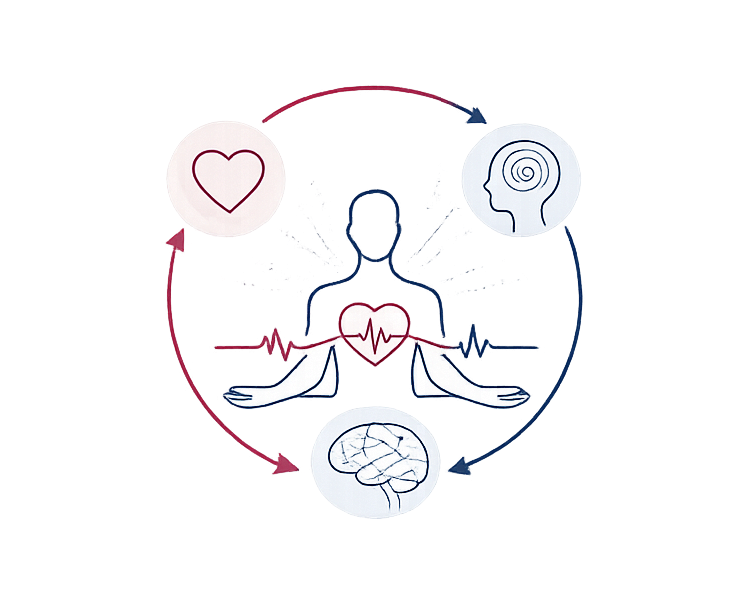
Physiological and psychological self-regulation are not separate processes. They are tightly interconnected.
Changes in bodily state influence how we think and feel, while cognitive and emotional processes shape physiological responses. For example, sustained worry or mental effort can maintain a state of bodily activation, just as fatigue or tension in the body can reduce attentional flexibility and emotional regulation.
Self-regulation therefore emerges from the continuous interaction between brain and body.
Flexibility as a core principle
Across both domains, a central feature of self-regulation is flexibility. A well-regulated system is not defined by constant calmness or constant activation, but by its ability to shift appropriately depending on the situation.
When this flexibility is reduced, the organism may become locked into patterns of overactivation or disengagement. This can manifest as persistent stress, difficulty recovering, or getting stuck in repetitive thought and emotional patterns. Such dynamics are commonly observed in chronic stress and various mental and physical health conditions.
A physiological window into self-regulation
One way to assess this regulatory capacity is through heart rate variability (HRV), which reflects the moment-to-moment adjustments in the timing between heartbeats.
Rather than directly measuring psychological states, HRV provides a physiological window into how flexibly the organism is regulating itself. Because of the close coupling between bodily and psychological processes, it can also offer indirect insight into broader self-regulatory functioning.
Can self-regulation be trained?
Just like HRV, self-regulation is not fixed. It can be shaped through practices that engage both physiological and psychological processes.
Mindfulness-based approaches, such as MBSR, develop the capacity to observe internal states without immediately reacting to them. This can help reduce habitual patterns and increase flexibility in how attention and emotions are regulated.
At the same time, approaches such as HRV biofeedback directly target physiological regulation by training the coordination of breathing, attention, and cardiac activity. This strengthens autonomic flexibility and enhances the connection between bodily and mental processes.
While these approaches differ in method, they converge in their aim: to strengthen the capacity of the organism to adapt.
Take-away: Self-regulation is not about controlling the system. It is about increasing its capacity to adapt.
References
1. Vohs, K. D., & Baumeister, R. F. (Eds.). (2017). Handbook of self-regulation: Research, theory, and applications (3rd ed.). Guilford Press
2. Gross, J. J., & Ford, B. Q. (Eds.). (2024). Handbook of emotion regulation (3rd ed.). Guilford Press
3. Gross, J. J. (1998). The emerging field of emotion regulation: An integrative review. Review of General Psychology, 2(3), 271–299. https://doi.org/10.1037/1089-2680.2.3.271
4. Thayer, J. F., & Lane, R. D. (2000). A model of neurovisceral integration in emotion regulation and dysregulation. Journal of Affective Disorders, 61(3), 201–216. https://doi.org/10.1016/S0165-0327(00)00338-4
5. McEwen, B. S. (1998). Protective and damaging effects of stress mediators. New England Journal of Medicine, 338(3), 171–179. https://doi.org/10.1056/NEJM199801153380307
6. Nolen-Hoeksema, S., Wisco, B. E., & Lyubomirsky, S. (2008). Rethinking rumination. Perspectives on Psychological Science, 3(5), 400–424. https://doi.org/10.1111/j.1745-6924.2008.00088.x
7. Kabat-Zinn, J. (2003). Mindfulness-based interventions in context: Past, present, and future. Clinical Psychology: Science and Practice, 10(2), 144–156. https://doi.org/10.1093/clipsy.bpg016
8. Lehrer, P. M., & Gevirtz, R. (2014). Heart rate variability biofeedback: How and why does it work? Frontiers in Psychology, 5, 756. https://doi.org/10.3389/fpsyg.2014.00756